Also visit Space Jockey Reviews at www.spacejockeyreviews.com for trailers, Rocket Meter ratings, movie news, short films, and more!
Showing posts with label Short Films. Show all posts

Wednesday, August 15, 2012

THE MOCKINGBIRD


If you suddenly needed to care, selflessly, for another—a family member, or perhaps even a sibling who had once cared for you—giving up most of your life in the process, could you do it? Could you return, repay, or at least, “mock” the kindness given to you? Before you say yes, stop and think. Do you really know yourself so well? Are there, perhaps, demons hidden within yourself you’ve only yet to meet? The Mockingbird is a short film by Rick Gawel that makes us consider, in a not so comfortable way, the most extreme albeit possible outcomes of such a need.

On second thought, “not so comfortable” is actually far too mild to describe the way The Mockingbird goes about confronting us with such possibilities. Horrific is actually more appropriate. “How?” you ask. Let’s begin with the beginning. A woman moves down a hallway, half awake, on her back, with overhead lights flashing by; an oxygen mask on her face, suggests she’s headed for emergency treatment somewhere, surely in a hospital. But, no! She’s being dragged by her feet! Where she’s being dragged and what’s about to happen are things I’m not about to tell. Let’s just say that it makes the unpleasantness above only child’s play.
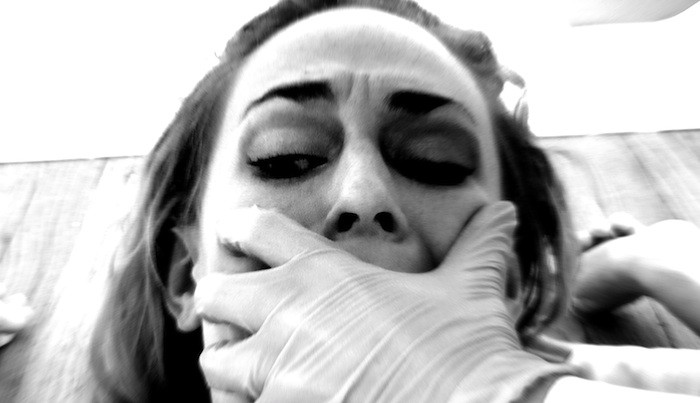

Madelyn Kennedy (Rebecca Steer) is a twenty-something woman suddenly confronted with the need to care for her sister, Evelyn (Melissa Malan). Evelyn is a once strong and independent woman robbed of her autonomy by an accident—one leaving her paralyzed from the neck down, condemned to a life of helplessness, confined to a bed. Evelyn is a prisoner in her own body, while Madelyn becomes a prisoner in her own home, haunted by commitment, guilt, and desperation.

What is most interesting about The Mockingbird is the in-your-face confrontation with transformation—deterioration into madness and the worst of what is human. With this change comes questions that involve us all; as viewers, we become as much a part of the story as Madelyn and Evelyn. Is the change the result of one susceptible individual becoming what few of us could? Or, are we too arrogant and vain to see the truth? Is it, instead, the result of forces grating on the senses to the point that any of us could become a monster? Is it, in fact, the rearing of an ugly nastiness, latent in us all, ready to spring forth and make us behave just as badly, beyond our control? Yes, what made me feel even more horrified was the thought of not really knowing myself—in the sense that inexperience makes it impossible. Setting aside what you think you know, and all of your most hopeful expectations, do you really know yourself? The Mockingbird makes us ask all these questions and more.

Rebecca Steer is an actress I have not seen before, but she plays her part as Madelyn with all the force necessary to give the movie its punch. Rebecca transforms her character from a pleasant, likeable woman, submissive, but otherwise “normal” on the surface. As the movie progresses, Steer shows her true talent by progressing her character accordingly, with impressive realism. Oddly, she makes Madelyn’s changes believable as much as they are bizarre and disturbing.

Before you think the part of a paralyzed woman cannot be difficult to play, think again. Melissa Malan has the challenging job of making Evelyn afraid, not with movement of the body, but only through looks on her face and terror in her eyes. Malan did this well enough to make me afraid just watching her; she made me feel as though I was, like her, unable to move, unable to defend myself, unable to do anything but be afraid. Without such a powerful performance as a bedridden character, The Mockingbird could not have been the success it is. Evelyn’s fear is a key part of The Mockingbird’s horror; Malan’s ability to communicate it to the viewer is what makes it real.


Director and editor Rick Gawel, along with cinematographers Tony Colon (and yes, Rick Gawel again), have created a horror film that stretches the boundaries of surreal cinema. As a reviewer, I must confess being partial to this type of film; however, with any objective view, The Mockingbird is a film that sets itself apart from others I’ve seen, visually as well as conceptually. Stark black and white, with strong highlights and high contrast, along with quivering overlapping images, gives the movie its surreal and most unique effect. Image shifts throughout intrude on the senses, unwelcome but imminent, forcing us, like Madelyn, to face the reality of human deterioration—physically as well as mentally. Bizarre camera angles make even reality seem unreal at times, helping to keep us unsure about objectivity, even when we assume it to be the case. With all the effects that Gawel and Colon deliver, the whole movie could be a nightmare…or so we think. Making us think again, however, we sense somehow that it’s not.

Added to these horrific visuals is a soundtrack that nearly drove me nuts—or should I say, as mad as the man in “The Telltale Heart.” Yes, I definitely should. A slow, pulsing repetition of noise (not music), grating on the nerves, making me want to turn it off. Before you think it’s a bad thing, think again. Like it or not, it’s a good thing here. This is a horror movie! Horrific, uncomfortable sound is delivered here with annoying perfection. I wanted it to stop, but it wouldn’t; I wanted to mute it, but I wouldn’t do that either, even though I could. Instead, I gave the movie every opportunity to make me uncomfortable; fitting with the story, it did that very well—as easily as a rope chokes a throat, a knife cuts the flesh, or any other thing causes pain, such as it does in The Mockingbird.

With the amount of special effects in The Mockingbird, no review could be complete without applauding Jenni Schenk—the one in charge of makeup and special effects. Blood and gore effects are not only copious, but just as copiously well done. Black and white, while toning it down, doesn’t allow for skipping quality…and Schenk doesn’t skip. With lesser talent, The Mockingbird might never have flown.

Never fear! There’s a lot more in The Mockingbird to fluff your feathers. There are nurses who draw blood—lots of it—and don’t wear shoes. Yes, they don’t wear shoes! Why? Who knows, but it’s another of the nightmarish details I like. Just like a dream, it just is. When it would make more sense for them to wear shoes, they don’t. There’s also a being with no name, possibly more important than we know. I can only guess who he might be. Do the same yourself, and see what you think. And, there are…well, lots of other things I won’t talk about here. Just watch the movie!


Oh! “What is the significance of The Mockingbird, as a title?” “What does it mean?” you ask? I’ll only say enough to be cryptic until you’ve see the movie. It is, I think, about punishment—how penance, in its most devastating yet effective way, is like a Mockingbird in its ability to imitate. The presence of such connections is another quality that makes The Mockingbird soar above the ordinary horror flick. There are metaphors to be found; rather than being disproved, they are talked about, living beyond the movie’s screen time, becoming something much greater.

The Mockingbird premiered at the Viaduct Theater in Chicago on August 6, 2011, as a part of the very first Herbivore Productions film fest—Herbi-Palooza 2011. It’s a 41-minute short film that packs all the punch of a full-length feature; it’s also the third film in Gawel's "Tortured Girl" trilogy. This is the first of these films I’ve seen, but, from the force of this one alone, I’ll be seeking out the others. The Mockingbird has style, scares, and suspense to spare, with surrealism that truly transcends reality—a Space Jockey favorite, easily!

With only one of Rick Gawel’s movies watched, I am already a fan of his work, looking forward to what else he produces. Herbivore Productions has found a unique niche in horror cinema; ironically, it’s at the top of the food chain in its niche, with not another plant eater larger than itself. At the heart of this herbivore is the human condition, haunting us with all its darkest possibilities. Is there a Madelyn lurking somewhere in us all? A possible horror for any of us of us is all the more horrific for all of us. With The Mockingbird, Gawel and Colon remind us of that, from beginning to end…from each bloody nightmare to every bloodier reality.

Starring Rebecca Steer, Melissa Malan, Joelle Weber, Kasey O'Brien, Steve Ruppel, David McNulty, and Brenda Arsenault, Directed and Edited by Rick Gawel, Cinematography by Tony Colon and Rick Gawel, Written by Melissa Malan and Rick Gawel, Produced by Brenda Arsenault, Makeup and Special Effects by Jenni Schenk, A Presentation of Herbivore Productions

Visit the Herbivore Productions website at www.herbivoreproductions.com
Visit Herbivore Productions on Facebook at www.facebook.com/HerbivoreProductions
Visit Herbivore Productions on Twitter at https://twitter.com/HerbivorePro

The Mockingbird Trailer


A Scene from The Mockingbird


Below is a great interview with actress Rebecca Steer who plays the part of Madelyn Kennedy. True to her character's condition, Rebecca is paralyzed and bedridden, complete with her oxygen mask. If you're not interested yet, check out the subtitled interview question! Enjoy! :)


Friday, May 25, 2012

THE GUEST – BEHIND THE SCENES

Here's an excellent behind-the-scenes video, showcasing the awesome filmmaking talents of Bryan Ryan--the writer and director of the short horror film, The Guest. The video features Bryan in action on the set, the actors and crew talking about their experiences, as well as comments from Bryan himself. I could say more, but I'll just let the video speak for itself. It's great! Check it out!


The entire short film, The Guest, is featured here on Space Jockey Reviews.  If you haven't seen it yet, check out the film and my complete review by clicking here!  Trust me; this is one you won't want to miss!

THE GUEST stars Alyshia Ochse, Willam Seay, and Suzanne Quast, Director of Photography: Will Barrett, Music by Dwayne Cathey, Editor: Brian Smith, Special Make-Up FX: Kelsey Boutte, Executive Producers: Mel House, Robert Galluzzo, Courtney Daniels, and Bryan Ryan, Co-Producers: Alyshia Ochse, Suzanne Quast, and Katie Floyd, Produced by Heather Wixson, Written and Directed by Bryan Ryan

Friday, May 18, 2012

THE UNINVITED VISITOR

 
“When you have a midnight visitor knocking at your door, will you answer?”

A young blonde is disturbed, during the night, by loud knocking at her door.  She assumes it’s someone she knows (John, she says) doing something unwelcome he’s done before—perhaps playing a practical joke, or worse, being an ex-boyfriend stalker.  Who knows?  The possibilities are endless, but mostly bad; we know, from the tone of her voice, that she’s not sure who it is herself.  The typical bluffs are played—“I’m not the only one here,” “My boyfriend is here,” and “I’m gonna call the cops.”  Of course, these aren’t clichés in the movie so much as they are clichés in life.  These are the things that people say when they’re really afraid, and the truth isn’t enough.

What does the blonde do?  Does she answer the door?  Does she get killed or become a killer herself?  I’m not about to tell you much about a film under four minutes long?  You’ll have to visit yourself to find that out.  Let’s just say that she does more than a few things that we all do, for better or worse, when confronted with the ever-dangerous impulse called curiosity.  Yes, that instinctive urge, said to kill the cat every time, is no less determined to drag humans to their doom just as quickly.  “What’s at the door?” you ask.  No matter how many uninvited visitors knock at my door, I’ll never tell!

When you finish watching The Uninvited Visitor, you may ask why I reviewed it.  (There’s always a few who do, no matter what.)  You may wonder what there is to say about a film under four minutes that leaves you hanging like a worm on a hook.  I would say it’s because the film encapsulates, in its short time, the key essence of horror—that fear and dread of the unknown, somehow making us risk all to discover it.  It’s about how we all wind up being the dumb victim of our own horror film, when we least expect it.  Is it that the girl is really dumb?  No.  It’s mostly that she’s human.

What about that home-alone girl, you say—the one drawn to the knocking as much as she is afraid of it.  Well, she’s a cliché who not only works, but also invades our senses with a necessary condition for fear—being vulnerable!  She’s home alone, in the dark, in shorts and a T-shirt, barefoot, and something damn nasty is knocking loudly at her door.  The girl (Katelin Petersen) is a horror heroine as beautiful as any I’ve seen before; yes, beautiful babes always make a good horror film better, and Katelin sure makes this one better!  Young women, in general, define vulnerability in the minds of most viewers; however, could we see Katelin kicking serious “visitor” ass in an upcoming episode?  Could Katelin become the Ellen Ripley of short film horror?  Could she champion the feminists and add eye candy for the guys—as a spandex-suited superhero, perhaps?  Like Katelin, curiosity is all we have for now!  In the meantime, I’ll keep my fingers crossed. :)

Okay, I’ve paid homage to Kaitlin’s status as a horror babe worthy of watching for her looks alone.  I had to do that, because…well…she deserves it!  “But, can this curious cutie act too?” you say.  Yes, absolutely, I say!  Kaitlin does the job she’s on screen to do, infusing character in an otherwise generic role.  She approaches the door, as cautiously and unwisely as she must.  She speaks with desperation and dread that makes us believe, emphasizing threats and scaring no one.  (Not once did I believe there was a boyfriend with a “bat.”  Not once did I believe she wasn’t alone.)  And her looks—her ever-important appearance on screen—goes beyond her being a hottie!  Katelin looks, naturally and skillfully, like the girl next door, alone and afraid, helpless and naïve, able to protect herself from nothing.  Oh, and her scream—it’s perfect!  (It actually scared me more than the thing that made her scream.)  Before you think I’m describing things anyone could do, think again.  It’s not as easy to be afraid of nothing as you may think—the nothing on the set, that is.  It’s not so easy to develop a character, from anyone to someone, in under four minutes.  I’ve seen many people do it very badly!  Kaitlin does it like a pro--a seasoned screamer who's been scared many times before!  In less than four minutes, Kaitlin, as the girl, becomes apprehensive, scared, and finally terrified, not as a stranger, but as someone I know and like.  Keep a lookout for Kaitlin; I’m sure you’ll be seeing more of her soon enough.

The Uninvited Visitor is episode 3 of Midnight Horror Show (MNHS); it’s produced by the two-man team of talent, Rudy Gold and Christian Guzman.  Currently, they release 1-2 episodes per month on their own youtube channel of the same name: Midnight Horror Show.  Each episode serves up a full dose of horror in record time; for movie watchers on the go (or those just wanting a fast thrill), Midnight Horror Show is the perfect fix!  Episodes move fast and punch hard!  From the strength of what I’ve seen, there are many reasons to keep an eye on what Rudy and Christian have in the works!  Check the Midnight Horror Show youtube channel for more!

With the directing of Christian Guzman and the cinematography of Rudy Gold, The Uninvited Visitor does the job of delivering horror in short order, with style as well.  All the fat is trimmed to serve up a lean scene of dread and suspense, without the typical fillers.  Rudy and Christian keep the camera at low angles, creating an eerie Peeping Tom effect—as if we’re watching from the cracks in the floor, or, perhaps, from under the door!  As the girl explores her now unfamiliar home, we, as the viewer, feel we are seeing it as the intruder; it’s as if we are oddly and uncomfortably participating in the terror inflicted on the girl—as if we are the intruder!  At other times, the camera shows us the girl’s perspective—or so we think!  Scenes are darkly-lit, with odd angles making things surreal as well as scary; shadows are menacing, but controlled, showing us just enough and never too much.  The editing, done by Rudy and Christian is also clean and well cut, just like the story itself.  It all flows smoothly enough, without plot confusion spoiling the buildup of tension.  In other words, when the “money shot” occurs, you’ll be focused enough on it to enjoy, or rather, be jolted by it.  You won’t be wondering what just happened here or there before.  Although you’ll get a helping hand, you sure won’t need it! :)

The original score by Erin Powell is perfect to compliment the 70s feel of the film.  Along with Erin’s score, Rudy Gold and Christian Guzman are able to pull off just the right retro effect.  The random, synthesized score keeps the viewer on edge, just as the girl, thinking anything could happen, at any time!  Music can easily make or break a movie, and Erin Powell’s score makes The Uninvited Visitor!

Possibly, the main reason I reviewed The Uninvited Visitor was to clear my head of thoughts it inspired.  You could even call them “uninvited” thoughts that just came wrapping, ever so loudly, at my chamber door—only that and nothing more!  “Quoth the Raven, ‘Nevermore.’”  Just like the girl in The Uninvited Visitor, my curiosity got the best of me; but, unlike the cat, the raven, and possibly the girl in the film, I’m still alive.  So, who cares!  Watch The Uninvited Visitor below!  Viewer discretion is not advised, but wise decisions are!

Starring Katelin Petersen, Guest Starring Christian Guzman, Directed by Christian Guzman, Directed by Christian Guzman, Cinematography by Rudy Gold, Edited by Christian Guzman and Rudy Gold, Original Score by Erin Powell, Sound Design by Christian Guzman, Executive Producer: Rudy Gold, Produced by Gold Standard, DIY Productions, and J Martin Films

Visit the MNHS youtube channel by clicking here!
Visit the MNHS Facebook page by clicking here!
Visit Katelin Petersen's Internet Movie Database page by clicking here!

Double click on the movie to view it in full screen.

Tuesday, May 15, 2012

TRESPASSER

As Trespasser begins, an alarm clock wakes a man in bed.  He could be any man, but soon we feel and see that he is not; quickly he becomes not only a stranger but something far worse.  Flashbacks and scenes from the moment tell a grim tale of something terribly wrong—of something getting even worse.  If I went on, I’d ruin the impact of a most effective short film, and, of course, I never like to do that.  I’ll only say that this man is a monster.

Human monsters are the worst and scariest of all, because they are real.  Even the most flamboyant villains from Hollywood—Pinhead, Freddy Krueger, Jason, and the like—are no match for those of the human kind that live each day, in the real world, stoking fears in the light as well as the dark.  Just the names of such killers are enough to disturb and chill the nerves of even the most desensitized of movie watchers.  I don’t need to name any here; we all know them.  (That one in your head right now probably has you a bit disturbed already.)

Trespasser is a short film that includes, as its main character, a generic man who could be anyone—the man next door, the man who teaches our children, the man who defends our case in court, ad infinitum.  He is methodical, apathetic, and cold, without concern for anything in his environment—other than what he needs for himself.  People are as disposable as trash—their bodies like useless packaging, after the product is consumed.  Human suffering is dispensed with purpose, as a routine, but never felt.

Already, I’ve explained the reason that Trespasser is so effective as a horror film, be it short or long.  It’s art imitating the worst things in life.  However, there is another element in this film that chills the marrow of even those most resistant.  I’ll only say that a child is involved.  Combining that with what I’ve already described should be more than enough to make the point.

Matt Fowler, the actor who plays the psycho, does it with creepy authenticity, as well as it could be done by anyone—even the best stars out there.  Although it may not take as much effort to portray someone with no emotions, in a silent role, for little more than three minutes, Matt certainly puts forth the effort and shows true talent.  For this, he gets a ten-rocket salute!  Matt's detached, unaffected appearance is chilling!  Katy Rowe also does a convincing job of portraying the tortured and terrorized victim.  As minimal as her role is, it is necessary and well done; she is the girl next door, the one we all know, and just like someone we all love.  I can only imagine that terrorized victims act as much like her; the fear on Katy’s face in the closing scenes looks real, fooling my imagination into believing it is.

Trespasser is another outstanding short film written and directed by Bryan Ryan.  (Bryan also directed The Guest, also featured here on Space Jockey Reviews.)  Trespasser, like The Guest, showcases Bryan’s ability to captivate an audience quickly, delivering a distilled but ever-potent dose of fear in record time.  No, he’s not the first to do a film on this subject, of course.  However, he pulls it off here as well as I’ve seen it done, in a fraction of the time it usually takes.

Trespass was shot and edited by Brian Smith.  Scenes flow smoothly, easily followed, with flashbacks that connect without confusion; scenes linger on the moments, giving (if not forcing) the viewer to think about what is happening.  Dwayne Cathey’s score is brooding and ominous, reflecting the dreamy, out-of-touch mind of the killer; Kelsey Boutte’s special effects make Katy Rowe look convincing as the victim, in anything but a dream.  All in all, the production team works well to create a film that fits all elements together successfully to achieve its effect.

Some of the most chilling scenes in Trespass occur as the credits roll.  In the end, the viewer is a witness to the killer’s recorded events, making things even more horrific.  Just when you think it’s over, it’s not; visuals are added at just the right moment to heighten the effect and make it stick.  Yes, Trespasser is a movie that hangs with you long after it’s over, even if you try to shake it off.

Why does Trespasser stick with you?  Again, it’s because it’s about reality—what happens everyday, somewhere, and what could also happen, at any time, to us.  The killer has no name, but his anonymity makes him all the more horrific; he could be anyone and everyone.  Trespasser reminds us, as a warning, that we, or our loved ones, with just the right mistake, could be his next victim.  What greater horror is there?  I say none.  Real horror is what reminds of what could happen to ourselves, and Trespasser reminds us of that from beginning to end.

Starring Matt Fowler and Katy Rowe, Written and Directed by Bryan Ryan, Shot and Edited by Brian Smith, Special Make-Up Effects by Kelsey Boutte, Music by Dwayne Cathey, A Final Girl Films Production

To watch the entire short film, click here!  VIEWER DISCRETION IS ADVISED!

Friday, April 20, 2012

CRESTFALLEN


Movies that tell a story without words are some of the most powerful.  Because there are no words, the visual palate of the film must paint its imagery all the more vividly in the mind of the viewer.  Crestfallen is just such a movie that, in the end, makes us feel we’ve heard everything spoken…and seen far more—that is, far more than what we we’re shown.   In only 6 minutes, the movie tells a story of depth and emotion that seems to have lasted much longer.

Crestfallen begins with scenes from someone’s life, familiar enough that they could be our own or from someone we know.  A montage of memories—images of love, marriage, happiness, and joy—are mixed with music that’s ethereal, and suddenly ominous, in a loop that leads us to something surely foreboding.  A woman enters a room, becomes a silhouette and disrobes, almost as an angel.  The only light from a window makes the scene both heavenly and gothic; mystery and desolation are, again, more telling of something less than happy ahead.  The woman submerges herself in the water of a tub in darkness, and emerges to bathe her face in light; yes, the juxtaposition of contrasts is consistent and sets the tone well—musically, physically, and emotionally.  (It’s a metaphorical light and dark difference as a theme.)   The woman studies a dagger, as if it’s sacred, turning it to reveal its angles as it shines in the light.  Next, a coup de gras moment floods the screen with more memories—those of despair, betrayal, and regret—along with the blood of her mortality; blood mixes with water, revealing more memories as it spreads.   As the camera tilts and turns, we feel the woman’s life draining from her—the disorientation and surreal moments of death (or so we think).
 
 
Yes, Crestfallen is about suicide (or rather about the process of it)—both mentally and physically, as it affects one woman, or anyone; that detail simply can’t be avoided.  Trying to keep it a secret is futile…and even pointless.  However, mentioning it doesn’t include a spoiler; the film is, I think, really about something more important—the vanity of life seen through the eyes of death.  Changes of heart are really the darnedest things, especially when they happen while the heart itself is dying.

No, I’m not going so far as to tell you that the woman (called Lo in the credits) lives or dies in the end.  I must leave something for you to discover (or decide for yourself) in this film I know you’ll watch.  Even though that seems an important detail (surely like the biggest spoiler of all), you’ll see for yourself that it really isn’t.   Again, I’ll refer to the process—rather than the product—that, in the end, seems most important.

Deneen Melody is a natural in her role as the woman silently telling her story.  Her angelic beauty conveys innocence, no matter what her thoughts reveal; sadness is felt, pure and untouched, from her soul, as if she really is the character she portrays.  Deneen’s captivates us, making us a part of her; the despair in her eyes is real and convincing, as if from experience.  While others may have played her role, others could not have played it better.  Deneen is comfortable and absorbed in her character, and her performance shows it; she portrays the poetry of Crestfallen with a style that makes it one to remember—and even one to watch again.   Deneen has previously starred in other short films—including Lewis and Blood Kin; she will also appear in an upcoming film titled Rose White (where Deneen is the writer, actress, and producer).   I look forward to seeing more from Deneen in the future; with her talent, she’s a star with the brightest of careers ahead!

The flow of Crestfallen is as smooth as running water; scenes glide from one to another with the streaming consciousness of thoughts and memories.  As I watched it, I felt swept along with the story and the music; the flow of events and rhythm kept me moving at the same pace, never compelling me to check the time or think of what I else I could be doing.  I really wanted to know what would happen next, from one scene to another, until the very end.

Crestfallen is a work of art without words; dialogue would only have brought it down to a more common level, making it like too many other stories of its kind.  It’s an example of how a tragic but ordinary story can become tragic and extraordinary.  Countless stories like Crestfallen are played out each day in life, but few are told so well as a work of art.

I would normally not talk as much about plot in a review, but Crestfallen is a film that must be analyzed as much as it is reviewed.  It’s a short film that is very concisely and fully about ideas and meanings that are literally in every frame of its running time.  Watching the story unfold for the first time—with all of its style and imagery—still leaves plenty to be seen, regardless of what you’ve read here or elsewhere.  In other words, I haven’t spoiled a thing!

Crestfallen was directed by Jeremiah Kipp.  He has directed numerous other short films including The Sadist, Easy Prey, Contact, The Pod, The Christmas Party, Snapshot, Drool, and The Apartment; he was also the assistant director of one of my personal favorites—I Sell the Dead.  Kipp, teamed with Dominick Sivilli as director of photography, creates a movie in a way that the mind thinks most creatively.  In Crestfallen, Kipp and Sivilli sweep the viewer along with poetic visuals, linking images and scenes that speak to our way of thinking and wondering, making even the surreal seem familiar.  The camera, under their direction, focuses on the ordinary, giving it extraordinary meaning; just the right lighting and angles on Lo’s instrument of suicide turn it into an object for thought and meaning beyond what it literally is.  Drops of blood spreading through water symbolize the movement of memories, blending with life…and death.  The turning and tilting of our perspective as Lo’s life drains away—along with familiar thoughts—helps us identify with even what seems beyond us.

Harry Manfredini is another who must be applauded here.  His score for Crestfallen is perfect for the mood of the film.  Along with the acting of Deneen Melody and the directing of Jeremiah Kipp, Manfredini’s musical score is the vital third part of the whole that makes it soar above the ordinary.  His music is haunting and foreboding, while, at the right time, ethereal, hopeful, and uplifting; it develops, with a life of its own, the poetry in the story, beyond the level of a simple narrative.   In a movie with no words, music is even more important, and Manfredini delivers exactly what’s needed.

Crestfallen is more than a movie; it’s a work of art in motion.  It’s definitely worth watching once, at least to understand the reasons to watch it more than once.  It’s like reading a good poem that you read often; it doesn’t take long, but it sure gives you lots to think about afterwards.  Put Crestfallen on your movie-watching list today!  It’s one of the best things you could do in 6 minutes!

Starring Deneen Melody and Michael Partipilo, Directed by Jeremiah Kipp, Director of Photography/Editor: Dominick Sivilli, Written and Produced by Russ Penning, Special Effects Artist: Arthur Cullipher

Watch Crestfallen on the Space Jockey Reviews website at www.spacejockeyreviews.com.  
VIEWER DISCRETION IS ADVISED!

Saturday, April 14, 2012

THE GUEST


More and more often, I find short films that truly deserve a full review, alongside any of the most mainstream movies out there.  The Guest is just such a movie that deserves its very own cinema showcase here on Space Jockey Reviews—and many other review sites out there.  The Guest, in its 14-minute running time, packs as much punch as most movies running much longer.  Suspense, dread, character development, plot, and all other essentials are generously included to make one seriously effective piece of horror that is sure to surprise all of those expecting the "same ole same ole."  In a world with so many predictable horror clichés, The Guest is one seriously welcome visitor!

As The Guest begins, we see the outside of any-house USA, and hear the familiar neighborhood dog and chirping crickets.  Inside, we see a girl—it could be any girl—washing dishes, in a dimly-lit kitchen, with the sights and sounds of a horror-movie victim in the background.  Yes, we feel vulnerable already, because it’s all so familiar.  Even if we don’t watch horror movies while washing dishes, the scene makes the viewer familiar enough to be a part of it.  The horror movie only makes us feel, reluctantly, a part of something dreadful ahead.  Suddenly, the news breaks to report a manhunt underway for—you guessed it—a man responsible for attacks and disappearances in the area!

I know, by now you’re thinking you’ve got this one all figured out.  But, trust me, you don’t!  If I say any more about the plot, I’ll ruin the film.  So, from here I’ll try to ramble and confuse you a bit, discussing things in a round-about, somewhat irritating way—that is until you finally appreciate not knowing, while watching the movie I know you’re about to watch (wink, wink).


The first eye-popping essential in The Guest is the first-rate acting of Alyshia Ochse and Robert Seay.  Alyshia plays Dana and Robert plays “The Man.” Alyshia has previously played the role of Irina Cassadine on the soap opera General Hospital, and I admit that I had never heard of Robert Seay.  These two actors are a very talented pair indeed; together, they make The Guest the success that it is.  Alyshia Ochse is as natural as any of the most seasoned professionals I’ve seen in horror films.  She is totally believable in every nuance of the part she plays as Dana, bringing the character alive in every scene.  As the vulnerable girl alone, her emotions, expressions, and fears are real enough to make us forget it’s a movie and she’s just a character in it—at least for some time, before our left brain yanks us back again.  (Unless you’re one of those film-watching conservatives who keeps chanting, “It’s only a movie, it’s only a movie….”)  I actually can’t say enough good things about Alyshia’s acting, and I was blown away by her performance—especially with her ability to transform her character so completely!  She's so authentic as an actress that she makes us feel as if we know Dana, whether we want to or not!  Dana is a complex character, and Alyshia fleshes out those complexities very nicely.  As for what else Alyshia’s acting talents fool us with, I’ll leave that to surprise you later.  Let’s just say that she easily takes her place on the pedestal of short-film leading ladies!  I predict that we'll be seeing a lot more of Alyshia, and she'll be taking lots more pedestals wherever she goes!

Yes, Robert Seay (mentioned earlier) also does a knockout job in his role as “The Man.”  Even with such a generic credit title, Robert is no such generic actor.  He does a great job of keeping us confused about who he is, whether he's one type or the other, while making us wary of his stereotype at the same time—over and over, right down to the screaming, bloody end of it all.  Oops!  Did I just say (I mean type) “screaming, bloody end”?  Yes, I did!  Well, at least I didn’t say who is screaming and who is bleeding.  Again, I’ll leave that for you to see and…yes, hear…in the end.

Other refreshing surprises about The Guest are in the variety of directions the film takes in its short time.  Just when you think you have one thing figured out, there’s something else to surprise you, leaving you with yet another thing you think you’ve figured out.  Okay, I could go on and on with that, but I’m going to stop right here again—at least one more time!  (Or, at least I hope so!)

The Guest is produced by Upstart Filmworks and Final Girl Films in association with S.L. Productions and Busted Buggy Entertainment.  (In an interview with Alyshia Ochse, I learned that S.L. Productions is actually Alyshia's own production company.)  The Guest was written and directed by Bryan Ryan.  Hollywood would do well to take notice and give Bryan a call to do a few films.  Like the actors in The Guest, Bryan’s talents are as professional as I’ve seen.  His objective use of the camera never reminds us that we’re seeing it through anything else but our own eyes.  The movement is fluid, natural, and just as we’d see it, if we were really there to see it.  Yes, some directors keep making us think of the camera—the mechanical, technical nature of it all—but Bryan doesn’t.

Okay, I know you’re probably wanting to know how much blood and gore there is in the The Guest—either because it’s a plus or minus in your thoughts about watching it.  My guess is, if you’re reading this, you’ll probably add a plus when I repeat the cliché, “Yes, there will be blood.”  But wait!  Don’t get too excited.  It’s not excessive.  It’s mostly in the faux-horror-movie scenes playing as background, and copiously in another scene that makes you wonder whether it’s in the movie or elsewhere—perhaps outside your own home?  Wait again!  Did I just say “copiously,” after saying it’s “not excessive”?  Yes, I did.  But, I think it’s because I’m trying to confuse you again, so you’ll be more surprised when you watch the movie.  Yeah, that’s it (wink, wink).

Special effects are also very well done, with the look of someone or something I won't describe (so as not to spoil it) having the effect of something on a much higher budget.  You won't see it coming; but when it does, you'll know what I'm talking about.  Overall, The Guest is a smaller budget movie with bigger budget effects.  Regardless of the cost, they're certainly "special," as well.

The Guest is another of the best short horror films I’ve seen, with an ending that’s far from predictable!  In a little over 14 minutes, it develops characters better than most films do in an hour and a half and packs as much suspense as well.  What’s more is that the acting is so substantial and exceptional that it further helps this short film seem more like a full-length feature.  I look forward to seeing more from Bryan Ryan, Alyshia Ochse, and Robert Seay; The Guest proves them to be quite a talented trio indeed!  In the meantime, enjoy The Guest in all of its 14-minute entirety, right here on Space Jockey Reviews; just make sure you don’t stay too long!

Watch The Guest on my website by clicking here, or visit the “Short Films” page there to view it in a slightly larger format.  Either way, I can think of many less productive ways to spend 14 minutes of your life—and I mean a list long enough to span light years of interstellar length!  Besides, if I don’t stop here, you’ll spend more time reading the review than watching the movie.  That just wouldn’t be right…would it?  Enjoy!

Starring Alyshia Ochse and Willam Seay, Director of Photography: Will Barrett, Music by Dwayne Cathey, Editor: Brian Smith, Executive Producers: Mel House, Robert Galluzzo, Courtney Daniels, and Bryan Ryan, Co-Producers: Alyshia Ochse, Suzanne Quast, and Katie Floyd, Produced by Heather Wixson, Written and Directed by Bryan Ryan
  
For an in-depth and very interesting interview with Alyshia Ochse on Dread Central, click here!  Visit Alyshia's Facebook page by clicking here!  See her IMDB page by clicking hereOf course, watch the film first!  VIEWER DISCRETION IS ADVISED! 

Monday, March 5, 2012

RED BALLOON


A voyeuristic journey into a house and through a hallway leads us closer to a female voice in the distance.  The voice, we see, is from a barefoot girl talking on the phone and painting her toes.  She’s happy, carefree, and relaxed, as if nothing but the next social event is on her mind.  We soon learn that she’s babysitting, being tempted to go elsewhere by a friend.  I know you’re already saying, “I’ve seen that before!”  Yes, I agree.  Vulnerable young babysitters are the clichéd, predictable victims of the best and worst of horror movies.  The body count for child-watching cuties ranks among the highest I know on the altar of horror cinema.

Yes.  Red Balloon could be like so many other horror movies we’ve seen too many times, but it’s not.  What makes it different, you say?  Believe it or not, for one, it’s that clichéd babysitter, or rather the girl who so perfectly plays her part.  Rachel Bright is the icon of a fresh-faced, home-alone teen, unaware of the horror-film hell ahead.  With acting talents beyond her years, she breathes life into an otherwise common character.  Rachel’s wide-eyed enthusiasm makes us interested in Julie, not caring that we already know her.  She is natural and authentic in her role, as if she is the terrified teen she portrays.

Besides Rachel’s great performance, she has another big ally in her arsenal.  No matter how many times I see a babysitting babe in for the gale force of terror, I never get enough!  Let’s face it.  The fear factor is based on vulnerability, and babysitters are on a short list of clichés that work.  There’s also a great way that Red Balloon keeps Julie from being the dumb girl who won’t leave when the door’s open.  Imagine that!

As for other clichés that work, we also have an evil child, an evil toy, and, yes, the obligatory “things that go bump in the night.”  That’s another terror-tale trio that, if done correctly, can work every time.  Evil children scare the $%*# out of me, no matter how many times I see them!  There’s something that violates nature when you see an innocent face capable of malevolent things.  Evil children in movies only need to look innocent while they’re doing evil things; Niamh Palmer Watson naturally does that very well, while looking adorable at the same time.  As for toys and noises in the night, that’s all I’m saying.  This trio of toys, children, and nocturnal noise works again in Red Balloon, as well as I’ve seen it work the first time elsewhere.  There’s a couple of others involving news and nightmares that I’ll leave unreported here.  It's as if the writers threw in "everything but the kitchen sink" to prove they could make something extraordinary out of the ordinary.

Where Red Balloon really rises above the rest is in the cinematography and the acting I’ve already applauded.  As for acting, there’s a very natural feel about the whole movie, with due credit for this again given to Rachel Bright.  The camera angles, lighting, and perspectives give Red Balloon a claustrophobic, voyeuristic feel—as if we’re seeing something we shouldn’t.  It also makes us feel uncomfortable, instead of just jabbing us with cheap thrill scares.  Directing and editing is tight and crisp, with scenes smoothly flowing from one chop to the next.  There are more than a few things Hollywood could learn from the directing of Damien Mace and Alexis Wajsbrot, the cinematography of Nat Hill, and the editing of Chris Hunter.  These are some talents to watch!  In one scene, the camera focuses on Rachel’s feet as she sits on a couch, suddenly zooming backwards, down the hall and out the window, until the viewer is in street outside.  This is all done in what appears to be a single take.  Excellent!  It’s one of those “How’d they do that?” moments!

Overall, Red Balloon is a great short film.  The story is predictable, but the actors aren’t.  We’ve all seen the terrified babysitter story, but we’ve never seen it done exactly like this before.  What’s better is that this story takes place in just under thirteen minutes!  It packs all the punch of many ninety-minute movies in a fraction of the time.  Red Balloon removes all the fat of most movies, dieting to a bare-bones appetizer if not an entrée.  Put Red Balloon on your movie-watching menu today!  Even if you don’t like the taste, it won’t last long.  

To see Red Balloon in its thirteen-minute entirety, complete with all the thrills and chills reviewed above, click on the movie below.  Or, to view it in a larger format, visit the "Short Films" page on my website by clicking here!  (It's the first movie, at the top, and, yes, it's worth the time to click on it and go there instead!)  Enjoy!

Starring Rachel Bright and Niamh Palmer Watson, Directed by Damien Macé and Alexis Wajsbrot, Written by Alexis Wajsbrot and Jimmy Pinto, Cinematographer: Nat Hill, Edited by Chris Hunter, Music by Martin Macrae, Produced by Damien Macé, Alexis Wajsbrot, and Kerri Trounce.